AI capability building

You know AI should be changing how your organisation works. It isn't yet.

Maybe you've experimented. Maybe you're still figuring out where to start. But the gap between "we should do something about AI" and actually doing it keeps getting wider. And harder to explain.

That gap isn't about technology. It's about capability.

It's just a 30-minute call. No pitch. You leave with a clearer picture. We move either way.
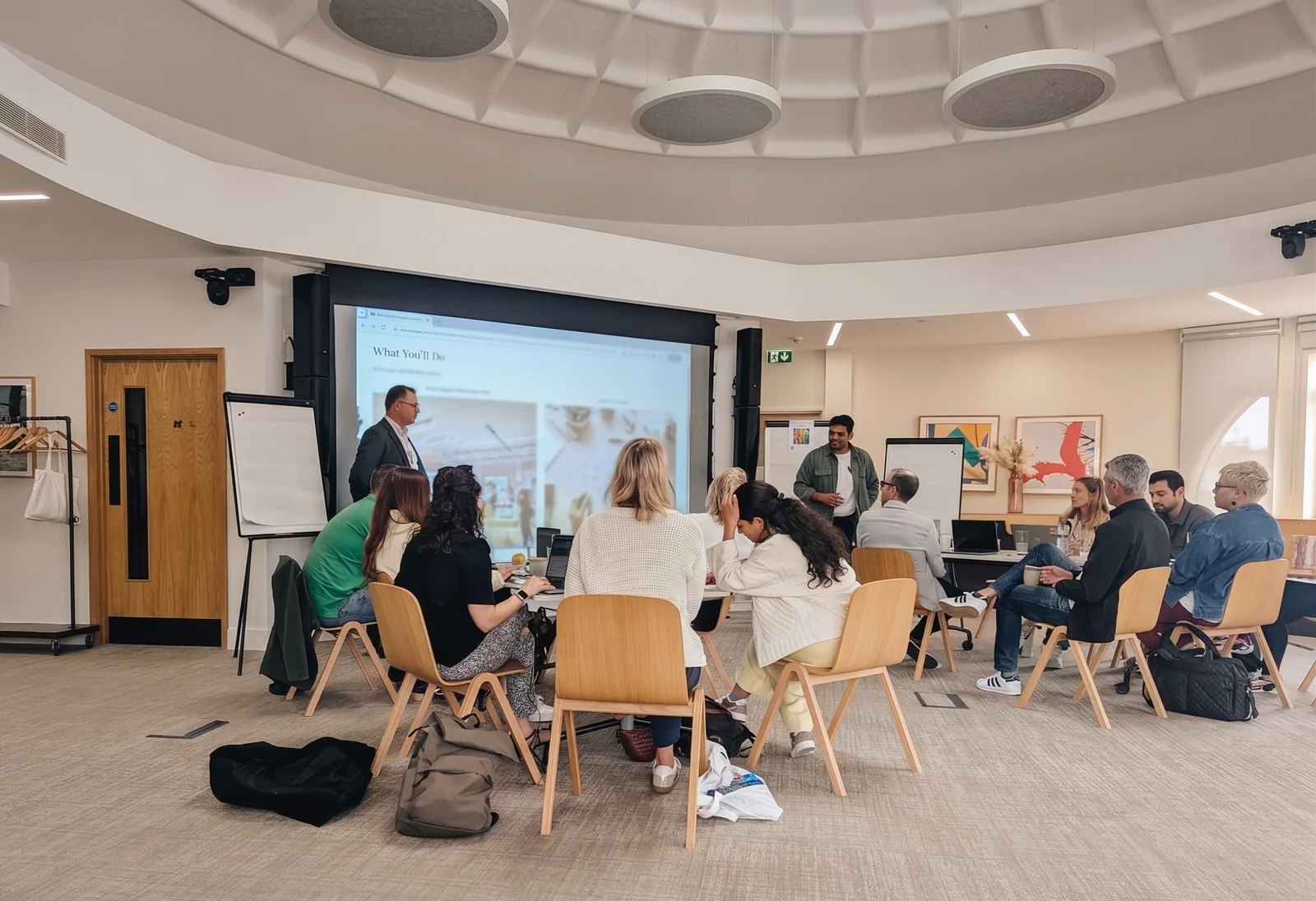
AI Potential capability-building workshop in session — facilitators presenting to a seated group of participants.
What you've probably already seen

Most AI initiatives leave nothing behind.

Tools get bought. People get trained. Six months later, the work hasn't changed and the team is back where it started.

Experiments that stall

A pilot ran, a deck was presented, and the tools never made it into real workflows.

Consultants you can't switch off

The capability never landed inside your team, so every change requires another invoice.

Tools the team won't touch

People sat through the training and went back to the way they were already doing it.

Competitors pulling away

Other businesses are moving faster on AI with smaller teams. The gap is widening, quietly.

What changes

What it looks like when AI capability actually lands.

The point of this work is not the technology. It's what the team does differently on a Monday morning.

01

More output, from the team you already have

Sales, marketing and operations move faster because the routine work is no longer the bottleneck.

02

Capability that stays with you

When we leave, the methods, agents and habits remain. You're not buying a dependency.

03

AI used in real work every day

Not demos. Not pilot projects. Tools showing up in the work that pays the bills.

04

You setting the tempo, not the consultants

Leaders who understand AI lead the firm differently. You become the source of the move, not the audience.

Who we are

We get it. AI shouldn't feel like another thing on the list.

What we hear from leaders

You are being told AI is the future. You are not being shown what to actually do with it inside your business. The advice is generic. The case studies are American. The vendor demos look amazing and then nothing changes in the work.

You don't want a strategy deck. You want fewer hours spent on admin, more time on the work that earns money, and a team that uses AI rather than hiding from it. You want to be the one leading this, not the one being briefed on it.

That's the gap we sit in. We install AI capability inside organisations like yours, working with the people who are actually going to use it, in the work that already matters.

Where we come in

AI Potential is built around one principle: capability, not dependency. The methodology is called the AI Capability Engine. It runs from advisory through to embedded operational capability in five deliberate stages.

01Five-stage operating method, refined across multiple SME and mid-market engagements.
02Working with organisations striving for excellence in their work.
03Capability stays with your team. The methodology: how to create agents and the routines to transfer to your people. No software you're tied to.
How it works

Five stages. We start where you are.

The AI Capability Engine. You don't have to start at stage one. We meet you wherever you are and move you forward from there.

01

Strategy

Get clear on where AI fits in your business and where it doesn't. Use case selection, leadership alignment, a credible plan.

Strategy
02

AI Fluency

Train your team on the foundations of practical AI use. Confidence, language, and the habits that make AI stick.

Fluency
03

Agent Building

Build the AI agents your team needs for their actual workflows. Not generic demos, tools for your work that save time.

Build
04

Application

Embed the agents and habits into day-to-day work, with the routines, governance and reinforcement that make adoption permanent.

Apply
05

Impact

The goal is excellence in the work that matters. Measure the change, adjust, and let capability compound into the standard you want to be known for.

Impact

What changes on Monday morning

From messy work to team-owned AI capability.

AI Potential turns stuck operational work into practical outputs your team can use, repeat, and improve.

Before

Busy work stays messy

5
Next into the engine
!

Proposal workflow

Manual research, old examples, and blank-page drafting slow every new opportunity.

Waiting
!

ISO audit workflow

Audit evidence is scattered across folders, inboxes, spreadsheets, and people.

Waiting
!

BD research workflow

Good outreach takes too long because every prospect needs research and personalisation.

Waiting
!

SOP workflow

Important process knowledge is stuck in people's heads instead of reusable documents.

Waiting
!

Customer response workflow

Routine replies still need too much manual judgement before they can be sent.

Guided by AI Potential

Your team owns the capability

We help your people turn stuck workflows into practical AI agents, working methods, and habits they can keep using after we leave.

With your team
Using your workflows
Owned by you
Not software. Not dependency. Capability installed.

After

Useful outputs land in the team

0

Time to first useful output

Hours, not days

Operating principle

Capability, not dependency

What stays behind

Agents, habits, methods

Who we work with

Six sectors. The same operating principle.

Different industries, different work, the same problem: AI capability that has to land inside the team without becoming a permanent consulting habit.

Sector 01

Manufacturing

SME and lower mid-market manufacturers facing audit pressure, capacity constraints, and a tight skills market.

  • ISO audit preparation and ongoing evidence
  • Quality, corrective action and non-conformance admin
  • Downtime, shift handover and SOP drafting
  • Sales, marketing and BD capacity
Sector 02

Professional Services

Consultancies, agencies, accountancy, legal and recruitment firms growing fee revenue without growing headcount at the same pace.

  • Proposal velocity and BD efficiency
  • Partner and fee-earner utilisation
  • Knowledge reuse and repeatable IP
  • Quality-controlled drafting and research
Sector 03

Construction & Built Environment

Specialist contractors, M&E firms, fit-out businesses and project management consultancies juggling tender pressure and project admin.

  • Tender and bid response, including PQQs
  • CDM, accreditation and regulatory documentation
  • Project handover packs, method statements, RFIs
  • BD pipeline and proposal velocity
Sector 04

Healthcare & Life Sciences

Private clinics, dental groups, veterinary chains and medical device SMEs balancing regulatory load with patient or customer growth.

  • CQC and quality compliance documentation
  • Patient and customer communication at scale
  • Clinical admin, protocols and SOP drafting
  • Marketing, BD and patient acquisition
Sector 05

Logistics, Distribution & Wholesale

B2B distributors and operators managing high-volume customer service, demand planning and account work with lean teams.

  • Customer service, returns and order admin
  • Demand planning and supplier communication
  • Driver scheduling, shift handover and incident reporting
  • BD, account management and outreach
Sector 06

Charities & CICs

Charities and Community Interest Companies delivering more programme work and impact under tight budgets and lean teams.

  • Grant application drafting and turnaround
  • Impact reports and trustee documentation
  • Donor and supporter communications
  • Programme delivery admin with small teams
Patterns from the work

What it tends to look like when it works.

Three examples from recent engagements.

Manufacturing

Mid-sized engineering firm: ISO audit prep

~60%
Less time on audit evidence collection

The Quality Manager went from spending three weeks of every quarter pulling audit evidence by hand to having a small set of internal agents that assembled the evidence pack and flagged gaps in advance. The capability stayed with the team after the engagement closed.

Professional services

Boutique consultancy: proposal velocity

Faster turnaround on new proposals

Partners stopped writing first drafts. A purpose-built proposal agent, trained on the firm's voice and past proposals, produced credible first drafts that partners shaped rather than created. Win rate stayed steady. BD time was halved.

Manufacturing

Family-owned manufacturer: BD capacity

+40%
Qualified outreach without new hires

The commercial director's outreach load was being limited by research time, not effort. A research-and-draft agent collapsed the front of the funnel, doubling outreach volume while keeping personalisation. No new headcount.

The longer story

Why AI Potential exists.

Most AI advisory work is built around the wrong premise. The premise is that the hard part is the technology. The hard part isn't the technology. The hard part is getting a team of busy people, with real jobs and real opinions, to use AI in the work that already matters.

AI Potential was built to solve that problem. We work with leaders who want AI to land properly inside their organisation rather than sit on the edge of it. The work is part advisory, part training, part build, and part embedding. We use a five-stage methodology because the problem has five distinct moves: decide where it fits, build the language and confidence, build the specific agents you need, get them into real workflows, and measure the change.

The principle underneath all of it is capability, not dependency. When we leave, the capability stays. The methods belong to your team. The agents are owned by you. The habits are visible in the work. We measure ourselves on whether you still need us, and our preferred answer is no.

If that's the shape of help you're looking for, the most direct first step is a short call. If you want to score yourself first, take the AI Clarity Benchmark below. It walks you through the eight decisions every leader has to make, and tells you honestly where you stand on each one.